The crossing

Our story · The crossing

From Dalbari and Mai to Mariënburg.

The oldest records we hold come from the immigration registers of the Hindustani contract labourers in Suriname. They are dry administration - height, skin colour, caste, ship, contract number - and they are all we have of the first two people in this tree.

1889

Durbarising sails

Durbarising (Mohansingh) Pahaladsingh, 24, leaves Calcutta on 3 August on the English ship Elbe. After 112 days, with storms in the Bay of Bengal, the ship anchors at Fort Nieuw Amsterdam on 23 November; the next day he is brought ashore in Paramaribo. His five-year contract on plantation Mariënburg is dated 23 November. Of the 34,000 people who made this crossing, he is the only one the register lists from his village, a name that cannot be found on today's maps.
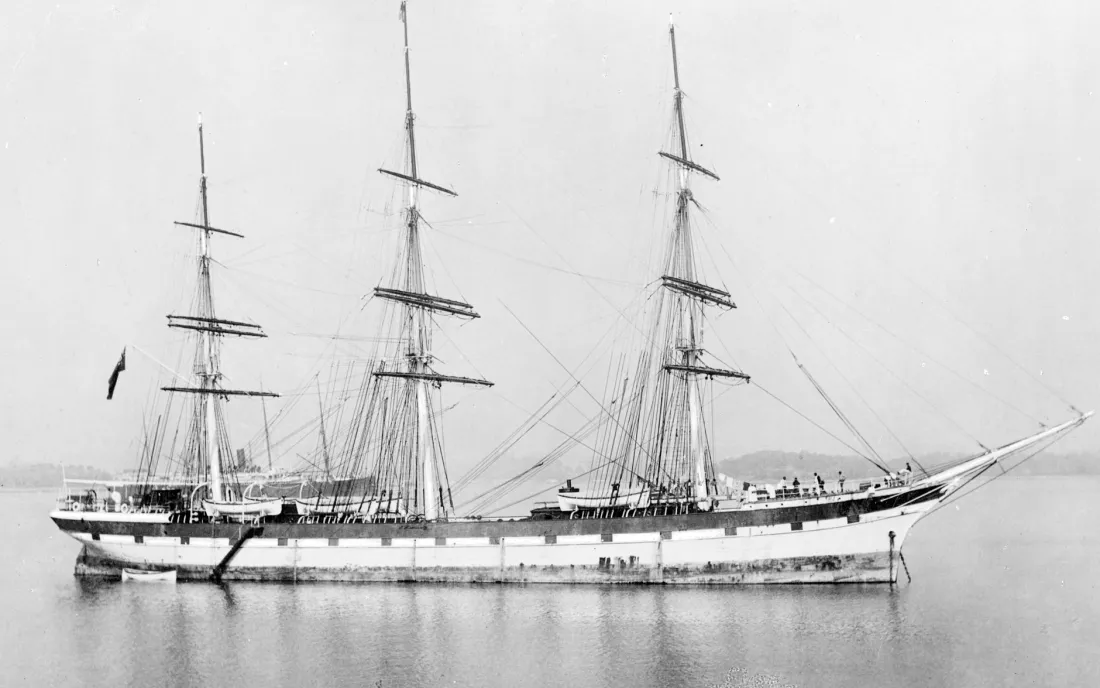
The iron three-masted sailing ship Elbe at anchor, seen from the side.
The Elbe, on which Durbarising sailed in 1889. State Library Victoria, H91.250/1477
What the register says
Register
R/1387
District
Deoghar · village Dalbari
Recorded
1.659 m · caste Chatri
Ship
Iron sailing ship of the Nourse Line, built 1887, 1,693 tons · number 374 on the ship's list · captain E. Hunt
Afterwards
Contract completed, discharged in the last quarter of 1894 · died 30 May 1909, act no. 1450
On board the Elbe, 1889
  • 2 August: 677 people board in Calcutta: 379 men, 152 women and 146 children. The ship leaves the next day.
  • Captain E. Hunt, ship’s doctor R. Sinclair.
  • From the second week: storms and a heavy south-west monsoon in the Bay of Bengal. The hatches stay closed; below deck it reaches 94 to 97 °F (34 to 36 °C).
  • 19 October: passes St Helena.
  • 14 children are born on board. 42 people die, 32 of them children; 17 deaths already in the Bay of Bengal.
  • Two doctors in Suriname inspect the ship. They find food, drinking water, medicines and hygiene in order, and conclude that the deaths cannot be attributed to neglect in treatment and nursing, but in their view mainly to the weather during the voyage.
“gedurende 14 dagen bleef de lucht zwaar bewolkt, regenachtig en ongedurig, zonder dat de zon zich liet zien”“for 14 days the sky stayed heavily clouded, rainy and unsettled, without the sun showing itself”, report of the two doctors in Suriname, based on the ship’s doctor’s notes (Koloniaal Verslag 1890, Bijlage J1, blz. 46)

Why some sources say 36 deaths: the Calcutta report counts only the 677 who boarded. The Surinamese count of 42 also includes 6 babies who were born and died during the voyage.

This voyage changed the rules. The report blames the deaths on the closed hatches and on the Thiers ventilator, “incapable of meeting the requirements of artificial ventilation”. A year later the Government of India banned that apparatus by notification of 23 October 1890, referring in so many words to the voyage of the Elbe to Surinam.

Sources

  • Koloniaal Verslag 1890, Suriname, Bijlage J1 (“Verslag betreffende de immigratie en kolonisatie over het jaar 1889”), § 3 “Aanvoer van immigranten”, blz. 46 (scanpagina 762): aankomst, kapitein E. Hunt, arts R. Sinclair, 677 immigranten, keuring op 19 november en het oordeel van de artsen. De tabel met 677 ingescheept, 14 geboren, 42 overleden en 649 aangebracht staat op blz. 47, net als de opgave van hun vroegere beroepen en van wie al eerder in een kolonie had gewerkt (scanpagina 763)
  • Annual Report on Emigration from the Port of Calcutta, 1889 (Protector of Emigrants D.W.D. Comins), tabel “Emigrant vessels despatched”, blz. 15: 112 dagen, 677 ingescheept, 36 doden, arts R. Sinclair
  • idem, blz. 16: “The heaviest mortality, 5.27 per cent., occurred on the voyage of the ship Elbe to Surinam”, met de Thiers-ventilator als oorzaak · de jaargang 1890 meldt het verbod op dat apparaat bij notificatie van 23 oktober 1890, uitdrukkelijk naar aanleiding van deze reis
  • Algemeen Handelsblad, 13-08-1889, rubriek Scheepstijdingen: “Calcutta 3 Aug. V. Elbe, Hunt, Suriname” · 26-11-1889: “St. Helena 19 Oct. ... Elbe, Hunt, Calcutta n. Suriname”

The Koloniaal Verslag appeared the year after the voyage: the 1890 report covers 1889, the 1896 report covers 1895. The newspaper reports are from the same days as the events.
Arrival in Suriname, November 1889
  1. 15 NovAnchors off the Suriname lightship. The ship lies too deep to cross the bar and has to wait for spring tide. (One newspaper gives 13 November.)
  2. 19 NovMedical inspection on deck, still at sea: “De zee stond hol”, the sea was running high. Men in two rows on deck, women and children on the quarterdeck.
  3. 23 NovTowed in by the government steamer Curaçao; at 7 pm the ship anchors at Fort Nieuw Amsterdam, after 112 days. This is the date on the contract.
  4. 24 NovTaken to Paramaribo by the steamers Curaçao and Nederland, landed at the pier of the Royal West India mail service and housed in the immigrant depot. 649 people arrived.
  5. afterAssigned to plantation Mariënburg. The exact date is not recorded; in 1895 employers came to collect their workers nine days after landing.

What they had done before: of the 649 who landed, 354 men and 132 women had been farmers or farm labourers. Nine men and 14 women had another trade: house servant, policeman, soldier, shopkeeper, weaver, errand runner or water carrier; three women had never had an occupation. And 73 of them had worked in a colony before: 32 in British Guiana, 11 in Rangoon, 9 in Natal, 6 in Jamaica, 5 in Trinidad, 3 in Mauritius and the rest on Réunion, Guadeloupe, Marie-Galante, Grenada and in Suriname itself.

Sources

  • Koloniaal Verslag 1890, Suriname, Bijlage J1 (“Verslag betreffende de immigratie en kolonisatie over het jaar 1889”), § 3 “Aanvoer van immigranten”, blz. 46 (scanpagina 762): aankomst, kapitein E. Hunt, arts R. Sinclair, 677 immigranten, keuring op 19 november en het oordeel van de artsen. De tabel met 677 ingescheept, 14 geboren, 42 overleden en 649 aangebracht staat op blz. 47, net als de opgave van hun vroegere beroepen en van wie al eerder in een kolonie had gewerkt (scanpagina 763)
  • Suriname, koloniaal nieuws- en advertentieblad, 26-11-1889: aankomst van de Elbe, het binnenslepen en de landing aan de KWIM-steiger
  • Suriname, 10-01-1890: de cijfers van de agent-generaal, 649 aangebracht

The Koloniaal Verslag appeared the year after the voyage: the 1890 report covers 1889, the 1896 report covers 1895. The newspaper reports are from the same days as the events.
1895

Gangajalia follows

Gangajalia Ganesh, 27, leaves Calcutta on the Erne III on 30 January 1895, the ship's third voyage to Suriname. After a calm crossing with a stop at St Helena on 31 March she arrives on 27 April. Her contract also runs at Mariënburg, until April 1900.

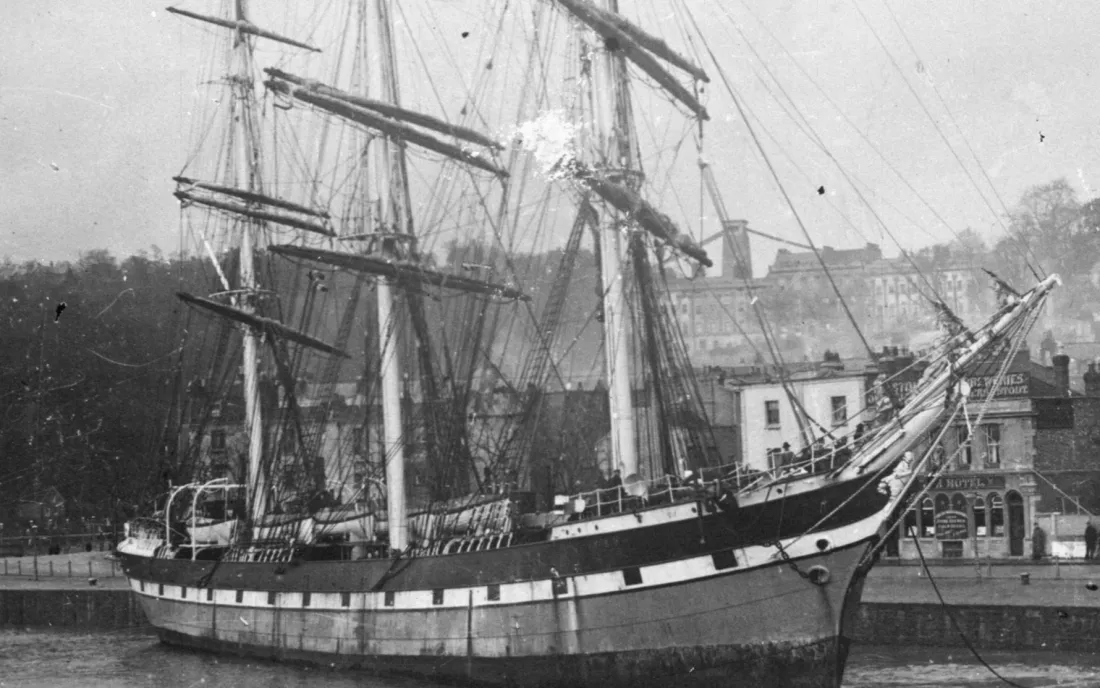
The three-masted sailing ship Erne moored at a quay, with houses behind it.
The Erne, on which Gangajalia sailed in 1895. State Library Victoria, H99.220/1426
What the register says
Register
X/215
District
Azamgarh · village Mai
Recorded
1.553 m · caste Thakur
Ship
Nourse Line, built 1886 · lost in an Atlantic storm in 1912
On board the Erne, 1895
  • 30 January: the Erne leaves Calcutta with 592 people, just after the normal emigration season had closed; the British authorities gave permission for an extension. (The Dutch trade paper Scheepvaart of 5 March 1895 gives 31 January.)
  • Captain D. Lardner, surgeon-superintendent Dr Charles E. Conran.
  • 23 March: passes Cape Point. 31 March: calls at St Helena for food and drinking water and sails on the next day.
  • 2 children are born on board; 3 people die, a man and two babies.
  • At the inspection in Suriname nothing is found wrong with the ship, the food, the water or the medicines.
“De immigranten zagen er jong, gezond en sterk uit. Zij brachten geen enkele klacht in, en verklaarden gedurende de reis zeer goed te zijn behandeld.”“The immigrants looked young, healthy and strong. They made no complaint at all, and declared they had been treated very well during the voyage.” (Koloniaal Verslag 1896, Bijlage K1, blz. 2–3)

She travelled alone. On the passenger list families carry consecutive contract numbers; around X/215 there is no child, no partner and no one from her village, and no second Gangajalia or Ganesh on the whole voyage. The “children: yes” on her card refers to children born later in Suriname. Whether she had been married in India, or left children behind, the register does not say.

Counted in the Indian Indenture Database (550 of the 594 contract numbers): 368 men, 173 women and 9 unknown, average age 20, with 89 children under twelve. Most came from Varanasi (56), Jaunpur (50) and Azamgarh (46). The only other passenger from her own police district, Gambhirpur, was X/36, Mohun Amir.

Sources

  • Koloniaal Verslag 1896, Suriname, Bijlage K1 (“Verslag betreffende de immigratie en kolonisatie over het jaar 1895”), § “Aanvoer van immigranten”, blz. 2–3 (scanpagina 875–876): vertrek, St Helena op 31 maart, arts Charles E. Conran, de inspectie van 29 april en de verdeling over de plantages
  • Nieuwe Surinaamsche Courant, 03-03-1895: bericht van de agent-generaal, “op 30 Januari l.l. van daar vertrokken het schip Erne” · Algemeen Handelsblad, 29-03-1895: “Cape Point gep. 23 Mrt. Erne, Lardner”
  • Bengal Proceedings P/4766, blz. 47–48 (Pros. nos. 14 & 15, File no. 10), januari 1895, British Library: “Extension of the Emigration season for Surinam in the case of the Ship Erne III”

The Koloniaal Verslag appeared the year after the voyage: the 1890 report covers 1889, the 1896 report covers 1895. The newspaper reports are from the same days as the events.
Arrival in Suriname, April and May 1895
  1. 27 AprSaturday afternoon: anchors off Fort Nieuw Amsterdam, after 87 days.
  2. 28 AprThe papers from Calcutta are handed in and found in order.
  3. 29 AprInspection on board.
  4. 30 AprBy the steamer Nederland and the schooner Thistle to Paramaribo; by morning everyone is in the depot. 591 people arrived.
  5. 2–3 MayMedical examination in the depot.
  6. from 9 MayEmployers collect “their” immigrants and they leave for the plantations, Gangajalia for Mariënburg.

What they had done before: 342 men and 143 women had been farmers or field labourers. Besides them one factory worker, six house servants and one shopkeeper, and two women who had never had an occupation. Thirty-two had been overseas before: 23 in Fiji, 4 in Mauritius, 4 in Guadeloupe and 1 in British Guiana.

Sources

The Koloniaal Verslag appeared the year after the voyage: the 1890 report covers 1889, the 1896 report covers 1895. The newspaper reports are from the same days as the events.
1899

A marriage, five children

On 28 June 1899 Gangajalia marries Mohansingh Pahaladsingh. Five children are recorded: Ramsardjoe, Mohansingh, Rajwantia, Rupnarainsing and Radjkoemar.

Births
1894 – 1906
Place
Suriname

Today

1,115 names

Seven generations later the family lives in Suriname, the Netherlands, the United States and Guyana - under Pahladsingh, Pahaladsingh, Parmessar, Sewgobind, Bharatsingh, Bharos and a hundred more names.

Newest
Born 2025
Sources
Registers, newspapers, the family itself
Which registers, exactly
  • Nationaal Archief, Den Haag index “Suriname: Contractarbeiders uit India” (nt00345): the immigration cards R/1387 and X/215, with village, caste, ship and the memo field
  • Indian Indenture Database the same two people in the Indian index, with the modern names of their districts and villages
  • Koloniaal Verslag 1890 and 1896 the yearly report to the Dutch parliament, scanned by Leiden University: the voyage of each ship, the inspection on arrival, the numbers and the earlier trades of everyone on board
  • Annual Report on Emigration from the Port of Calcutta, 1889 the departure side of the same voyage: days at sea, people embarked, deaths, and the ship’s doctor
  • Delpher, Koninklijke Bibliotheek Surinamese and Dutch newspapers from those same days: the shipping notices and the arrival reports
  • Nationaal Archief Suriname the civil registration: the record numbers of the five births, the marriage of 1899 and the death in 1909
  • The family itself what the elders told while they were still with us, plus memorial cards, photographs and the corrections the cousins keep sending in

The five children, as the register lists them

Every birth in the memo field of her immigration record carries a place and the number of the birth certificate, so each line can be ordered as a document.

Name in the register Born Place Certificate
Ramsujus Sing2 January 1894MariënburgAg 1899 No 406
Mohun Sing4 July 1896MariënburgAg 1473
Rajwantia3 November 1900MariënburgAg 1900 No 281
Rupnarainsing24 September 1903MariënburgAg No 2281
RajkumarSing4 June 1906MariënburgAg 1906 No 1956

Two things worth knowing. All five were born on the plantation, so the family stayed there until at least 1906. And our own tree has Rupnarainsing at 1902, while both the register and the 1921 census say 1903.

How to read a contract number

Every immigrant was registered with a letter and a number. The letter is the year the ship arrived, counting from A for 1872; the number is the person. So R is 1889 and Durbarising was the 1,387th immigrant registered that year. Gangajalia’s X/215 puts her in 1895.

Carrying a family number of your own? Type it here and the archive’s own list of ships will tell you which crossing it was.

Why there are so many spellings

The variants are not sloppiness. The family name was chosen, person by person, half a century after the crossing. Rajwantia chose Pahladsingh on 19 October 1945, Radjkoemar on 11 April 1947, Ramsardjoe on 31 December 1952, and Roepnarain chose Pahaladsingh on 16 September 1955. Their children chose again in Nickerie in 1975, and cousins in other branches became Oedayradjsingh and Laigsingh. Four counters, four days, and already two spellings of one name.

An open question

Gangajalia arrived in Suriname in April 1895. A later note in her immigration record lists Ramsujus Singh as born on 2 January 1894 at Mariënburg. Those details do not fit together. The same record uses the word erkend, legally recognised, for the children on 28 June 1899, which is the act used for children born outside a marriage. We are looking for the original register entry and the document referenced as “Ag 1899 No 406” before drawing a conclusion.

The next names to find

The same memo field names the contract numbers of families who married into ours: Sew Gobind Singh 154/Hh, Baboeram 70/Ll, Ramlall 1517/Gg, Ramsaroop 1971/M, Sewraj Komar 1393/M, Laik Singh 289/P. Each of those is another immigrant with a ship, a village and a file of their own. Of the 1,115 people in this archive, exactly two have their crossing documented so far.

The oldest names we own

The register has two name columns, and the archive explains what they mean: the first is the immigrant’s own name, the second is the name of their father. Read that way, R/1387 says his own name was Pahaladsing, which is where the family surname comes from, and that his father was called Durbarising. X/215 says her father was called Ganesh. Those two men never left India, and their names were in the archive all along. To be confirmed on the original cards.

Durbarising & Gangajalia

Our story · Where the family begins

The two who made the crossing, as the archive wrote them down.

Durbarising stepped ashore in 1889, Gangajalia in 1895. Everyone in this archive, all 1,115 of us, descends from these two. And this is the whole of what the colonial administration recorded of them: a height, a skin colour, a caste, a village, a number.

R/1387

Durbarising (Mohansingh) Pahaladsingh

Elbe, arrived 23 November 1889

Age on arrival
24
Height
1.659 m
Skin colour
dark brown
Distinguishing marks
none recorded
Caste
Chatri
Work in India
field or factory labour
Village
Dalbari
Police post (thana)
Gaichan
District
Deoghar
Recruited by
the colonial government
Number on the ship list
374
Employer
agents of the Nederlandsche Handel-Maatschappij, administration of plantation Zoelen
Plantation
Mariënburg
Contract
23 November 1889 to 23 November 1894
In the memo field
Discharged in the fourth quarter of 1894. Died 30 May 1909, act no. 1450.

In the Indian Indenture Database

Registered there as
Durable Pahaladsing
Place as written in 1889
Dalbaric · Gaichan · Deoghar
Matched to today
Daldali · Palojori · Deoghar · Jharkhand

His card in the Dutch national archive His record in the Indian Indenture Database

X/215

Gangajalia Ganesh

Erne III, arrived 27 April 1895

Age on arrival
27
Height
1.553 m
Skin colour
brown
Distinguishing marks
pockmarked
Caste
Thakur
Work in India
field or factory labour
Village
Mai
Police post (thana)
Gambhirpur
District
Azamgarh
Recruited by
the colonial government
Number on the ship list
404
Employer
agents of the Nederlandsche Handel-Maatschappij
Plantation
Mariënburg
Contract
27 April 1895 to 27 April 1900
In the memo field
Married to R/1387 and the children recognised, 28 June 1899. The five births at Mariënburg, with their record numbers.

In the Indian Indenture Database

Registered there as
Ganesh Gangajalia
Place as written in 1895
Mai · Gambhirpur · Azamgarh
Matched to today
Mai · Lalganj · Azamgarh · Uttar Pradesh

Her card in the Dutch national archive Her record in the Indian Indenture Database

He also turned up in India

The Indian Indenture Institute has put the records of indentured labourers online, and R/1387 is among them, as “Durable Pahaladsing” - a misreading of the handwriting. The Indian fields repeat the Surinamese card, so it is not an independent source, but the project adds its own guess at the modern place: Palojori, Daldali, in Jharkhand. We treat that as a lead, not proof.

The men beside him in the register

The same database shows who carried the numbers next to his. R/1386 was Karam Sing from Hariharpur in the district of Gaya; R/1388 was Gulab, thirty years old, from Soti Chak near Patna. Both boarded the same ship. He himself is the only person in the whole register of 34,000 immigrants who came from Dalbari.

How to read these fields

The village is the last place someone lived in India, not necessarily where they were born. The age was an estimate by a clerk. The caste was what the emigrant said it was. And the number on the ship list, 374, is the number a family needs to search in Indian archives, together with the ship and the year.

On the muster roll

The contract number was handed out on arrival in Suriname. The muster number was the list made in Calcutta: the order in which people came aboard. That order is the only record of who they actually stood next to.

The Elbe, Calcutta, 3 August 1889

  1. 369–372 Bhattu, Tetri, Sohorai and a child of six one family, Patna, village Pankri
  2. 374 Pahaladsing, son of Durbarising · 24 Deoghar, village Dalbari · R/1387
  3. 385–390 Gujari, Ghuraho (two years old), Ramkhelaon, Parbotia Gorakpur, Basti, Azamgarh, Murafaspur

The numbers in between are missing from the index. He travelled alone, in a queue of families. From his own village, Dalbari, he is the only person in the entire register of 34,000 immigrants; three other people from the Santal Parganas sailed on this ship, but from other villages. Everyone else around him came from Shahabad, Patna, Gya and Monghyr, the districts where the recruiters worked.

The Erne, Calcutta, 30 January 1895

  1. 402Ramkalia · 28Ghazipore · X/213
  2. 403Nanki · 25Benares · X/214
  3. 404Gangajalia, daughter of Ganesh · 27Azamgarh, village Mai · X/215
  4. 405Bigani · 30Arrah · X/216
  5. 406Gharbasawan · 9, her sonArrah · X/217
  6. 407Sumeri · 26Jaunpur · X/218
  7. 408Mulki · 35Jaunpur · X/219
  8. 409Mungari · 7, her daughterJaunpur · X/220

Eight women travelling alone and two children, each from a different district, every one of them bound for Mariënburg. The list was partly ordered by sex, so she did not board as a lone woman: she boarded in a row of them.

Both rows come from the immigration register of the Nationaal Archief Suriname, searched on ship and muster number. The register is not complete for every voyage, so a missing number means the sheet was not indexed, not that nobody carried it.

How he ended up in Calcutta

Our story · Calcutta, 1889

Nobody was recruited where he came from.

In his district the colonial agencies did not recruit at all. So how did a man from the Santal Parganas end up on a ship to Suriname? The Protector of Emigrants in Calcutta explains the mechanism himself, in his report over that very year.

Large numbers of free emigrants are brought from recruiting districts ostensibly in connection with emigration to Assam, many of whom eventually find their way to the colonial agencies. Tea-planters are somewhat particular as to the class of labourer they wish to import; if the supply is sufficiently great, they reject all those who, on account of caste or previous employment, are not suitable — they want aboriginal tribes from Chota Nagpore, “first class junglies”. There remains in the depots of these free agents in Calcutta a very considerable number of coolies who have not been selected for Assam, and these are offered to the agents for colonial emigration. Annual Report on Emigration from the Port of Calcutta, 1889, pages 7 and 8

Read with the numbers beside it, that paragraph is his story. He was a Chatri, and the tea-planters wanted exactly the opposite. Whoever was turned down stayed behind in the depot and was offered to the colonial agents, registered at Alipore, and written down as “recruited in Calcutta”. His district, police post and village were then spoken out loud to a clerk who had never heard of them, which is the most likely explanation for spellings like Gaichan and Dalbari that exist on no map.

What is documented: the mechanism, the figures and the quotation. What remains an interpretation: that Durbarising himself walked this road. His card does not name the place where he was registered, so we cannot prove it - we can only show that he came from a district where no recruiting took place, in a year when two thirds of all Surinamese emigrants were registered in Calcutta itself.

16.813people registered in 1889 for emigration to the colonies, across all of British India
68of them born in the Santal Parganas, his district
0registrations in the Santal Parganas: the district is not on the list of registration districts at all
3.394people registered in the 24-Pergunnahs, around Calcutta: two thirds of everyone who sailed for Suriname that year
13of those 3,394 were actually born there. The rest had been brought in
31.000inhabitants of the Santal Parganas were working in the tea gardens of Assam around 1901. That was where his district’s labour went

What the Santal Parganas were

The district he came from lies in the hills and forest of south-eastern Bengal, in what is now the state of Jharkhand; Deoghar, the district named on his card, was one of its four sub-districts, and it included Jamtara. The British carved the area out in 1855, straight after the Santal uprising, and gave it a separate, light administration: parts of it had no police stations at all, only headmen with a policeman’s powers. It is named after the Santals, an Adivasi people with their own language; our family belonged to the Hindi-speaking families who had settled there, around the pilgrim town of Deoghar with its Shiva temple. People did leave this district in their tens of thousands - in 1901 more than 31,000 of them were counted in the tea gardens of Assam, two days away - but hardly anyone left by ship. Against those tens of thousands stand the 68 who were registered for the colonies in all of 1889.

Sources

After the plantation

Our story · 1907 – 1921

The records follow Gangajalia beyond the plantation.

Gangajalia’s contract ended in April 1900. A handful of later records give us glimpses of where she and the five children went, with years still missing between them.

1907 – 1910

A plot on Schotelweg

Gangajalia’s immigration record says she took over the use of plot 12 on Schotelweg in 1907. That use was transferred to another person in 1910. The record does not tell us whether she lived there. The same years hold two entries that sit five days apart: on 25 May 1909 she exchanged her right to return to India for a premium from the colonial treasury, and on 30 May 1909 Durbarising died.

1916 – 1919

Three births and a small grave

Rajwantia, the only daughter, has three children in these years: Gaurisankar in September 1916, Samrattia at the Kwattaweg in 1917, and Oedeban Sing at Mattonshoop in 1919. Gaurisankar dies on 1 December 1916, three months old, cause unknown. So in these years the family is still in Beneden-Suriname, not yet in Nickerie.

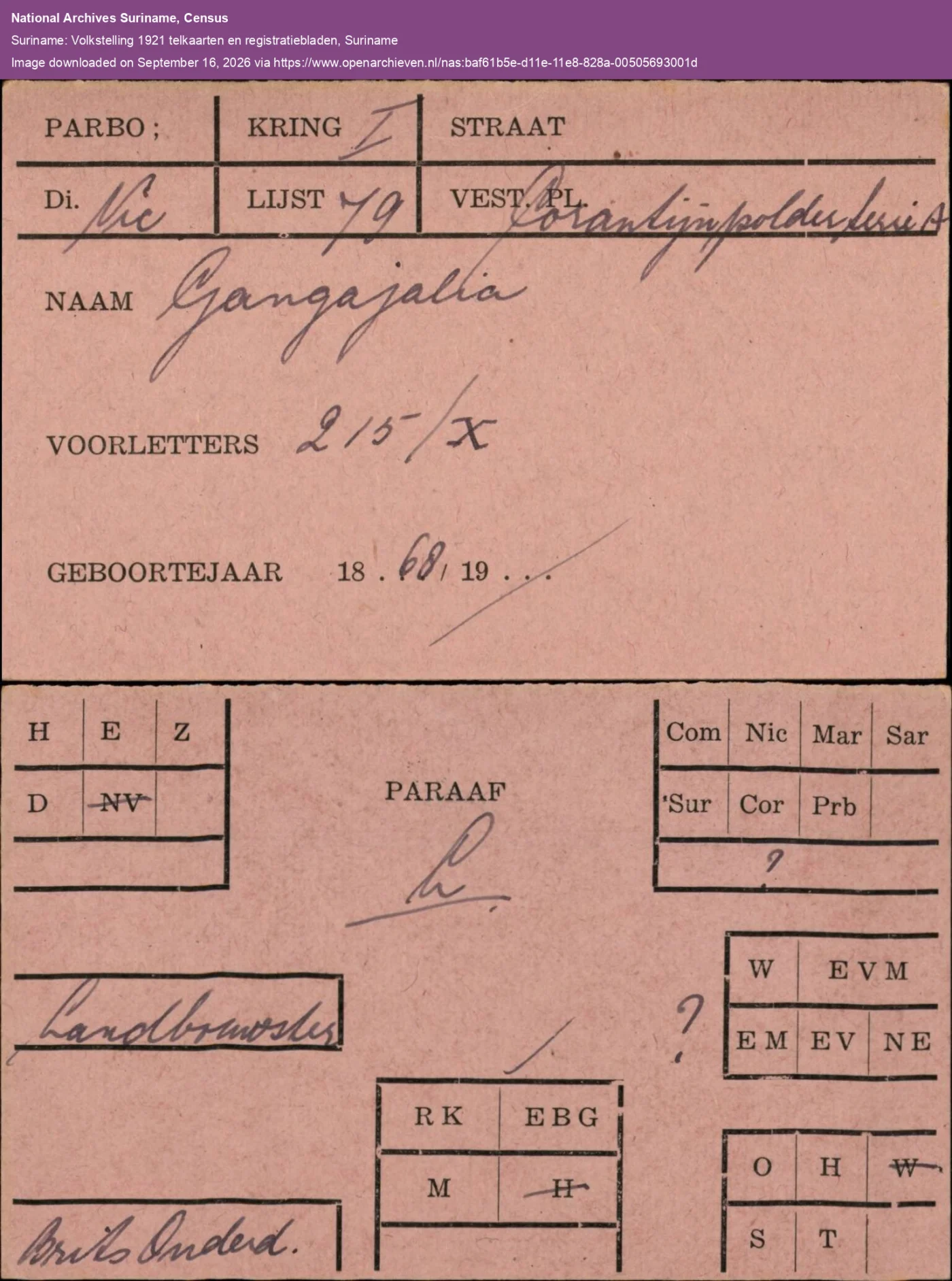
Census card from 1921 with the handwritten name Gangajalia and the number 215/X.
Her own census card. District Nickerie, kring I, list 79, Corantijnpolder serie A. Year of birth 1868, and in the clerk’s hand her occupation: landbouwster, farmer. Nationality: British subject. Nationaal Archief Suriname, Volkstelling 1921, via openarchieven.nl

1921

A trace in Nickerie

A census index lists Gangajalia, identified by her contract number 215/X, in the Corantijnpolder in Nickerie. When she went there, and why, remains to be found.

A story that survived outside the registers

The family tree holds one note that no archive could have supplied. It says that Gangajalia named Bhola Singh as her dewar, her husband’s younger brother, and that to prove the connection she told how he came by his hump: as a small boy in India he climbed a tree to pick something for his ajie, his grandmother, and fell. It reached this archive the way such things do, passed from mouth to mouth and written down generations later. We have looked, and found it in no register and in no other source. Take it for what it is: the family’s own memory of something that happened in India, and the only thing here that is not paper.

Family tradition. Heard and written down by the keeper of this archive; the chain back to Gangajalia is spoken, not written, and cannot be checked.

These are index entries; the original register and census sheet have not yet been checked.

The route

Our story · The route

Two villages, one crossing, four countries.

Durbarising left from Dalbari, Gangajalia from Mai. Both were gathered at the Surinam emigration depot at 20 Garden Reach, Calcutta, sailed around the Cape of Good Hope past St Helena and came ashore at Paramaribo. Everything after that - Nickerie, The Hague, and the cousins in the United States and Guyana - follows from those two crossings.

The route of the family A map from the villages of Dalbari and Mai, by ship around the Cape of Good Hope and past St Helena to Paramaribo, on to Nickerie, and from 1975 to the Netherlands. Soft rings mark the countries where the family lives today: Suriname, the Netherlands, the United States and Guyana. India Africa South America Europe 1889 and 1895 · on the Elbe and the Erne III three to four months at sea from 1975 United States Guyana Mai Dalbari Calcutta Cape of Good Hope St Helena Paramaribo Nickerie The Hague

Drag the map sideways to follow the whole route.

  • Port of departure or arrival
  • Recorded stop
  • The move to the Netherlands, from 1975
  • Where the family lives today
Distances are as the crow flies, calculated from the coordinates of the places themselves. The coastlines are drawn by hand and deliberately rough: this is a route, not an atlas. The villages are marked approximately: Dalbari cannot be found under that name today, and Mai probably lay near the police post of Gambhirpur.

1889 · 1895

India to Suriname

From the village to the depot at Garden Reach, and from there down the Hooghly to the open sea. Sailing ships could only leave Calcutta for Suriname between July and January. The Elbe left in August 1889 and needed 112 days; the Erne left in January 1895 and took 87 days, stopping at St Helena for water and food.

Route
Calcutta → Cape of Good Hope → St Helena → Paramaribo
Distance
About 20,000 km, around the Cape and via St Helena
In company
34,000 people on 64 voyages, 1873 – 1916

1889 – 1921

Inside Suriname

The five children are all born at Mariënburg. Then a plot on Schotelweg, births at the Kwattaweg and at Mattonshoop, and by 1921 the census finds Gangajalia far west in the Corantijnpolder, with the border river in sight.

Route
Mariënburg → Schotelweg → Beneden-Suriname → Nickerie
Distance
About 200 km west, from sugar cane to rice
Sources
Immigration register, census of 1921

1975

On to the Netherlands

Around independence the family crosses an ocean for the second time, now by plane and in one day. The tree records births and marriages in a dozen Dutch towns; The Hague and Rotterdam hold the most.

Route
Nickerie → The Hague, Rotterdam, Utrecht, Leiden, Nijmegen, Tilburg, Emmen
Distance
7,550 km in about nine hours

Today

Four countries

Seven generations on, the family lives in Suriname and the Netherlands, in the United States, and in Guyana - which from Nickerie is no further than the other bank of the Corantijn.

Countries
Suriname, the Netherlands, the United States, Guyana
Still missing
The towns abroad; the tree has no places for them yet

Everything up to 1921 comes from the immigration registers and the census. The Dutch towns come from the tree itself. The United States and Guyana come from the family, not from a record - so if your branch lives there, tell us where, and the map gets more precise.

In pictures

History · In pictures

No photograph of them survives. These are the places they passed through.

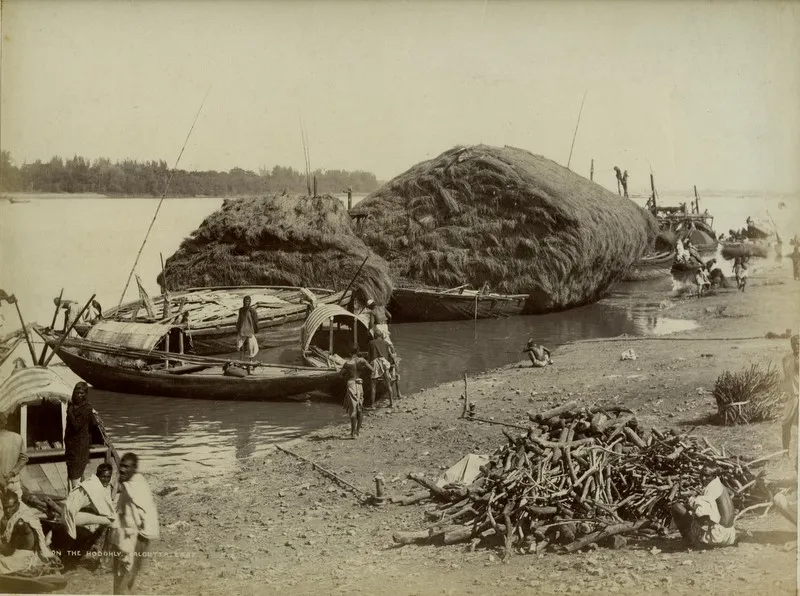
We have no portrait of Durbarising or Gangajalia - only their register entries. But the river they sailed from, the depot they arrived in and the cane fields of Mariënburg were photographed in exactly those years.

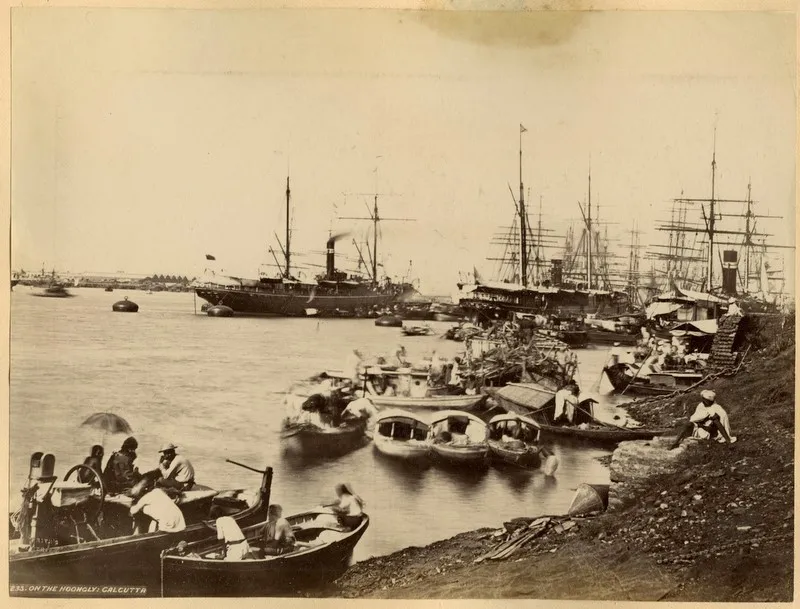
The Hooghly river at Calcutta with sailing ships at anchor, around 1880.
The Hooghly at Calcutta, with sailing ships at anchor. The Elbe sailed from this river with Durbarising on board on 3 August 1889. Francis Frith, c. 1880s · public domain · Wikimedia Commons
Boats and riverbank life on the Hooghly at Calcutta, around 1880.
Riverbank life on the Hooghly - the last of India that the emigrants saw. Bourne & Shepherd, c. 1880s · public domain · Wikimedia Commons
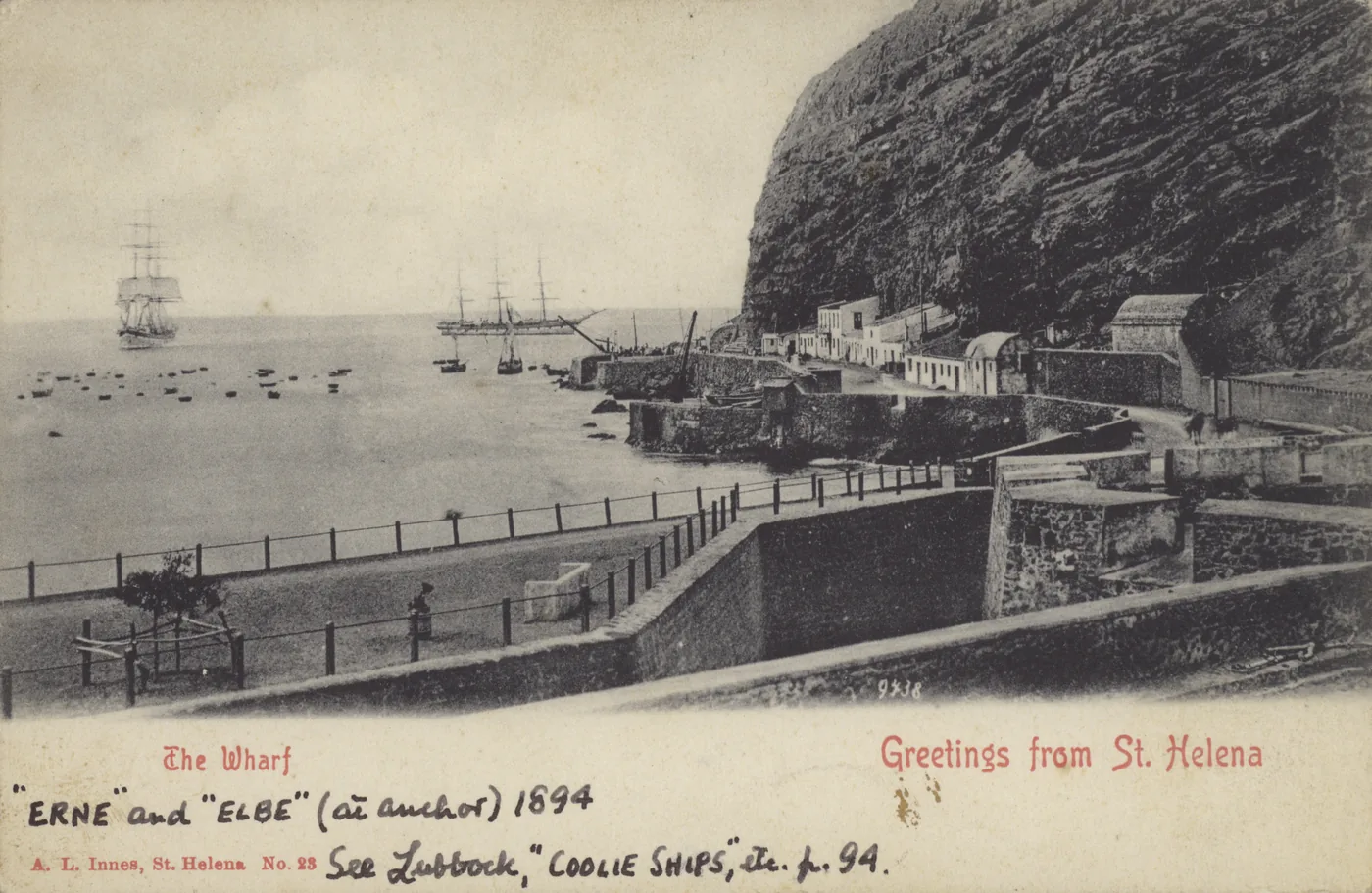
Postcard of the wharf at Jamestown, St Helena, with two square-rigged sailing ships at anchor in the bay.
The wharf at Jamestown, St Helena. On this postcard a collector wrote in ink: “ERNE” and “ELBE” (at anchor) 1894, with a reference to Basil Lubbock, Coolie Ships and Oil Sailers, page 94. Both ships of this family in one frame: the Elbe carried Durbarising in 1889, the Erne carried Gangajalia in 1895. The naming of the two ships is the annotator’s, not the publisher’s. Postcard A. L. Innes, St Helena, no. 23, 1894 · Look and Learn / Naylon Maritime Collection / Bridgeman Images · licensed
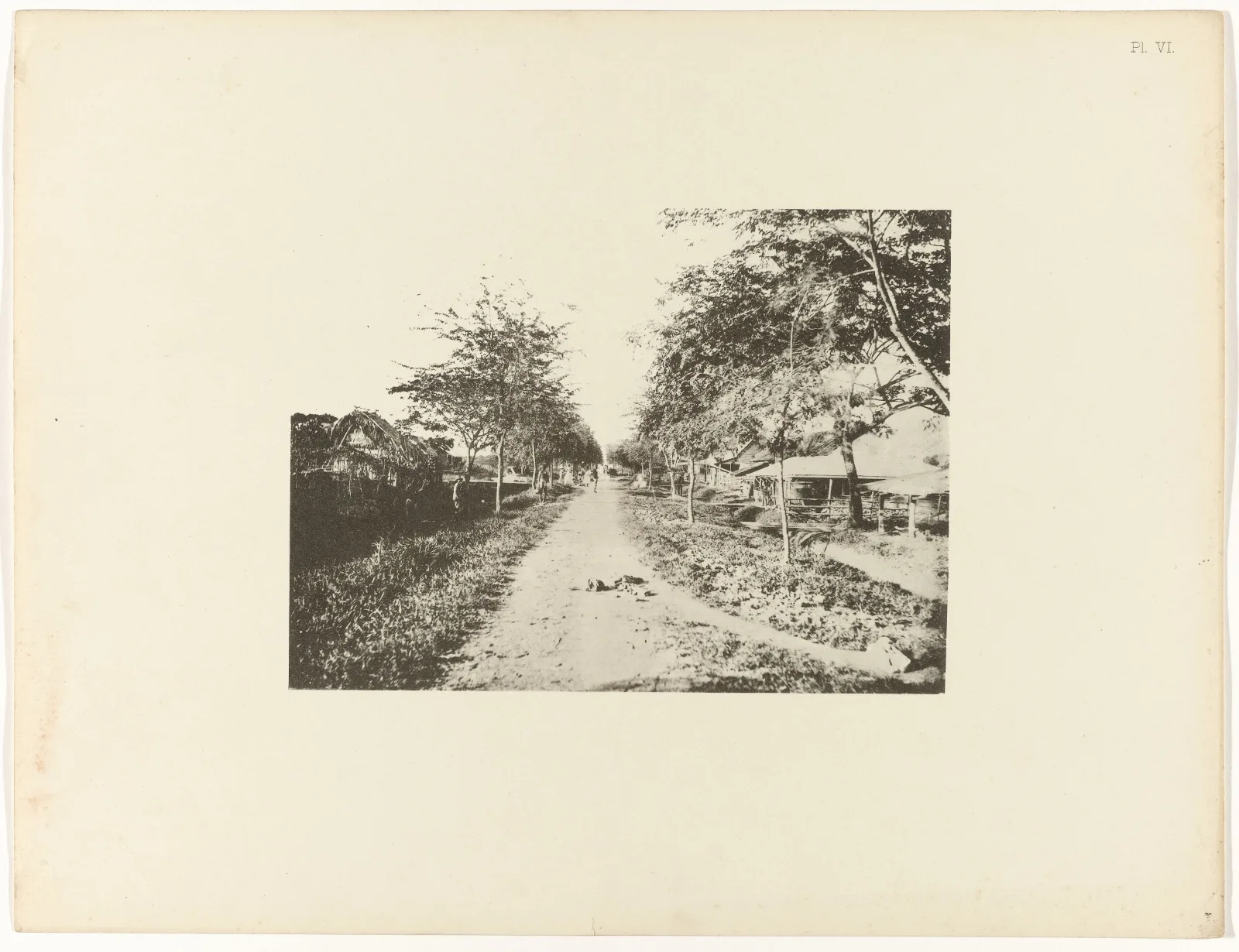
The tamarind avenue on plantation Mariënburg in Suriname, photographed in 1896.
The tamarind avenue on Mariënburg, 1896 - the plantation road in exactly the years the family was bound to this place. Julius Muller, Rijksmuseum, RP-F-1994-16-6, 1896 · CC0
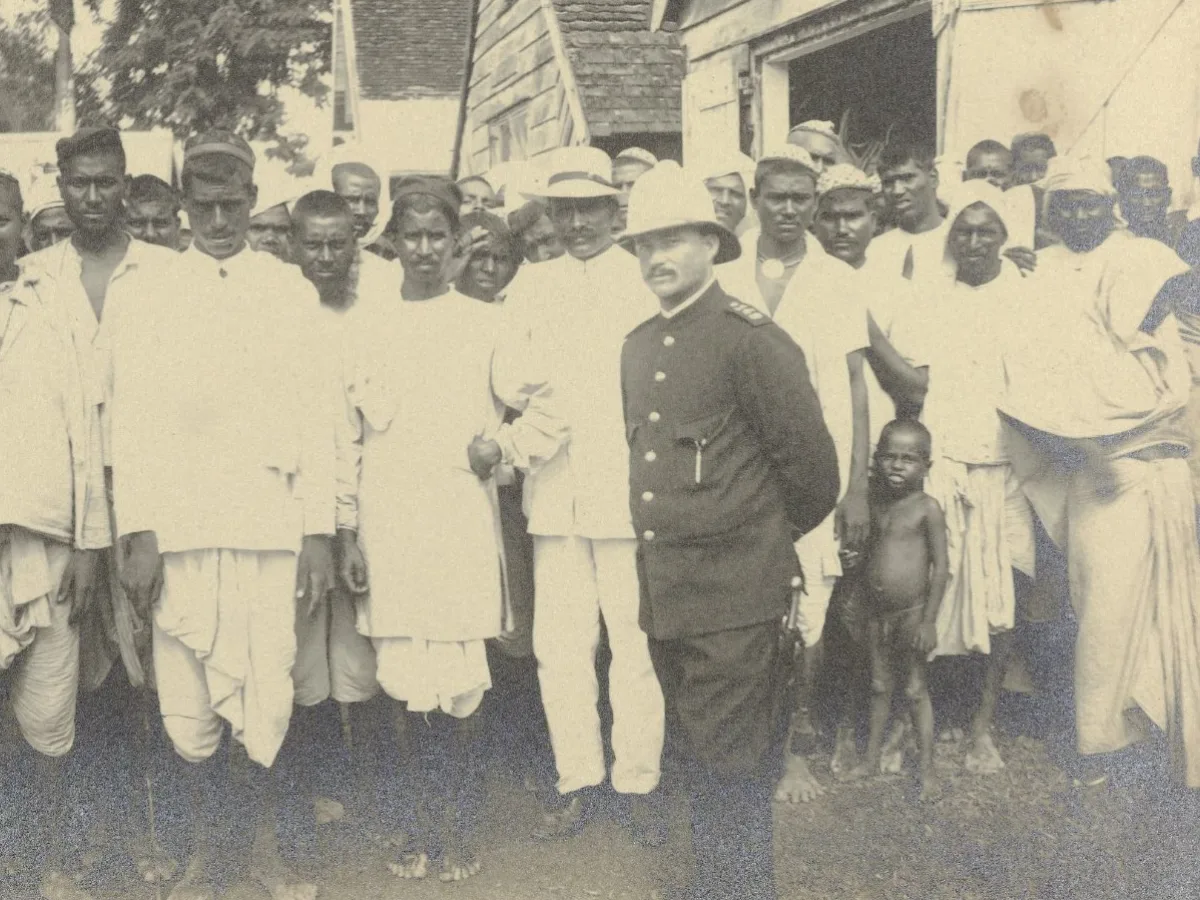
Hindustani contract labourers with an officer in uniform in the courtyard of the immigrant depot in Paramaribo, 1891.
The immigrant depot in Paramaribo in 1891, between the arrivals of Durbarising and Gangajalia. Every new arrival was registered here and assigned to a plantation. Rijksmuseum, NG-1994-65-4-11-1, 1891 · CC0
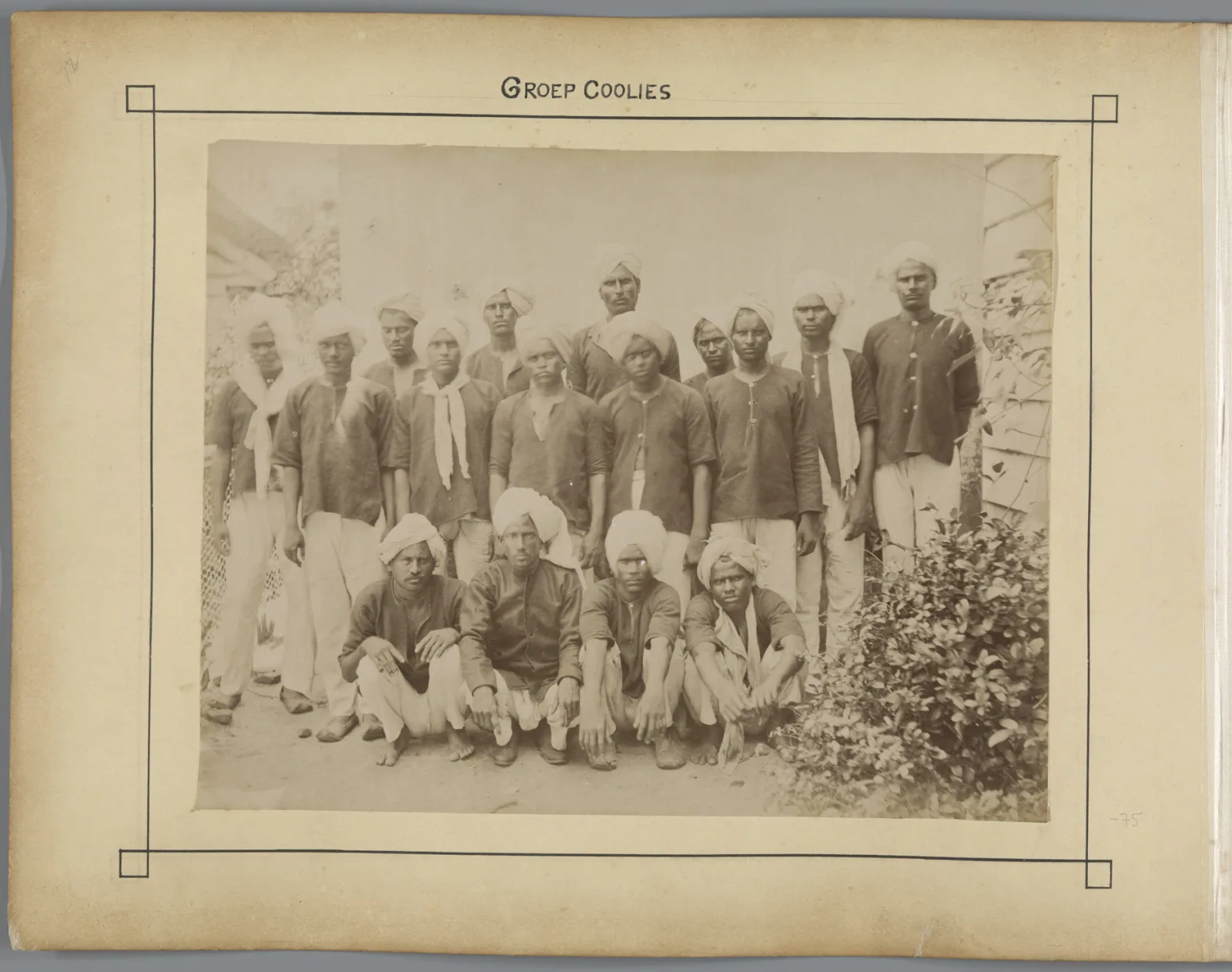
Group portrait of Hindustani contract labourers in Suriname, around 1900.
A group of contract labourers, photographed in the years Gangajalia’s contract was running. Rijksmuseum, NG-2015-4-1-75, 1898–1902 · CC0
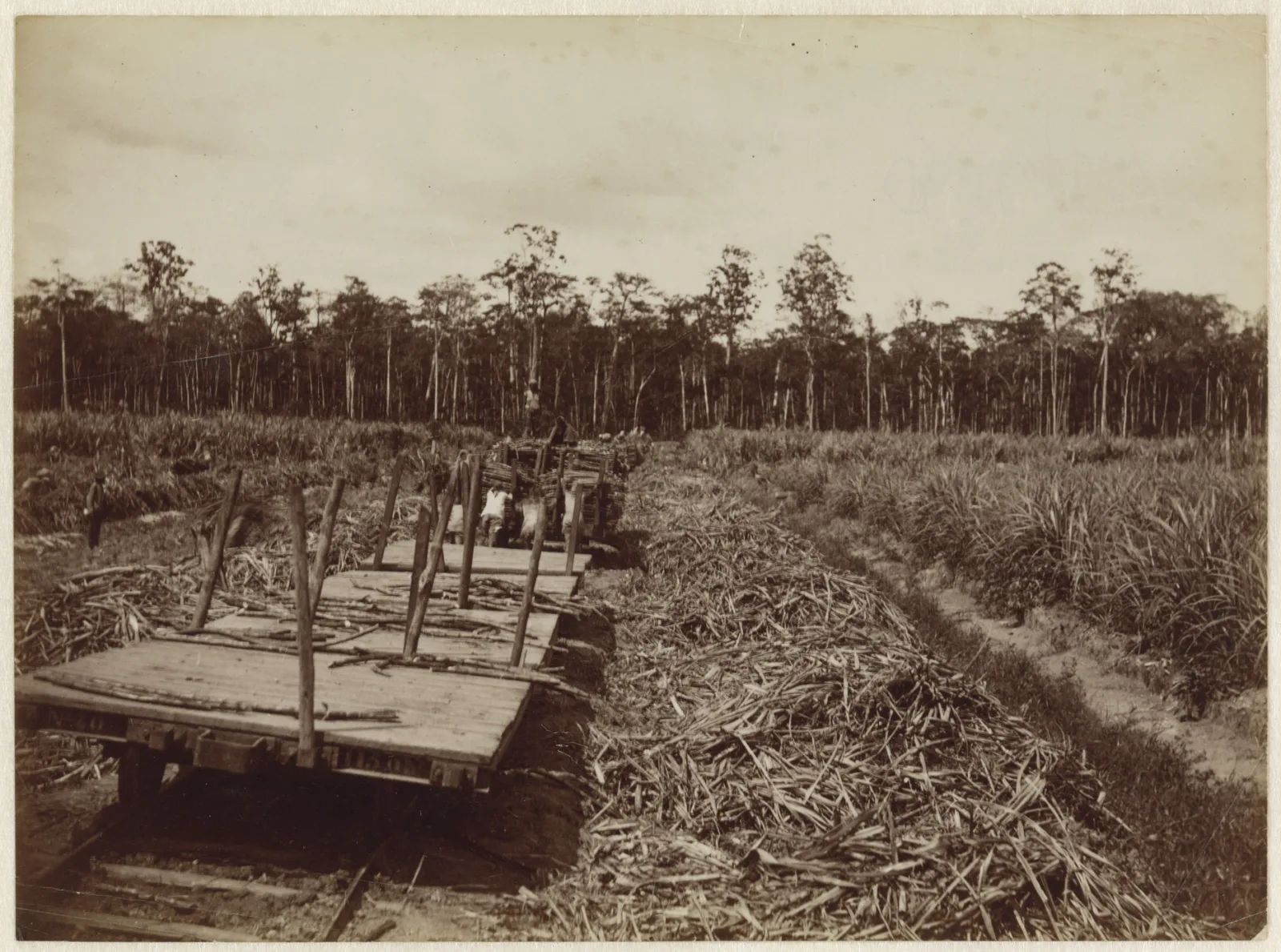
Cane cutters harvesting sugar cane at plantation Mariënburg, Suriname.
Cane cutters on sugar plantation Mariënburg - the plantation where both of their five-year contracts were served. Rijksmuseum, NG-2015-4-8, 1882–1902 · CC0

These are documentary photographs from the Rijksmuseum and Wikimedia Commons, free of copyright (CC0 or public domain), except the postcard of St Helena, which was licensed from Bridgeman Images and may not be copied from this page. None of them shows our own family - they show the places, the ships and the years. Family photographs will replace them here as soon as they are scanned.